Payment Orchestration and Smart Routing: How Transactions Are Optimized
Learn how payment orchestration and smart routing optimize transaction paths, improve authorization rates, and shape modern payment infrastructure performance.

Card authorization decisions are often attributed to issuing banks. In practice, a significant portion of the outcome is determined earlier in the transaction lifecycle.
Payment orchestration and smart routing define how transactions are processed, which acquirer handles them, and how they are presented to card networks and issuers.
For payment providers, acquirers, and merchants, these systems represent a primary control layer for improving authorization performance.
Quick Answer: What Is Payment Orchestration and Smart Routing
Payment orchestration is the infrastructure layer that manages how transactions are routed, processed, and retried across multiple payment providers.
Smart routing is the decisioning component within orchestration that determines the optimal path for each transaction based on performance, geography, cost, and issuer behavior.
Typical routing flow:
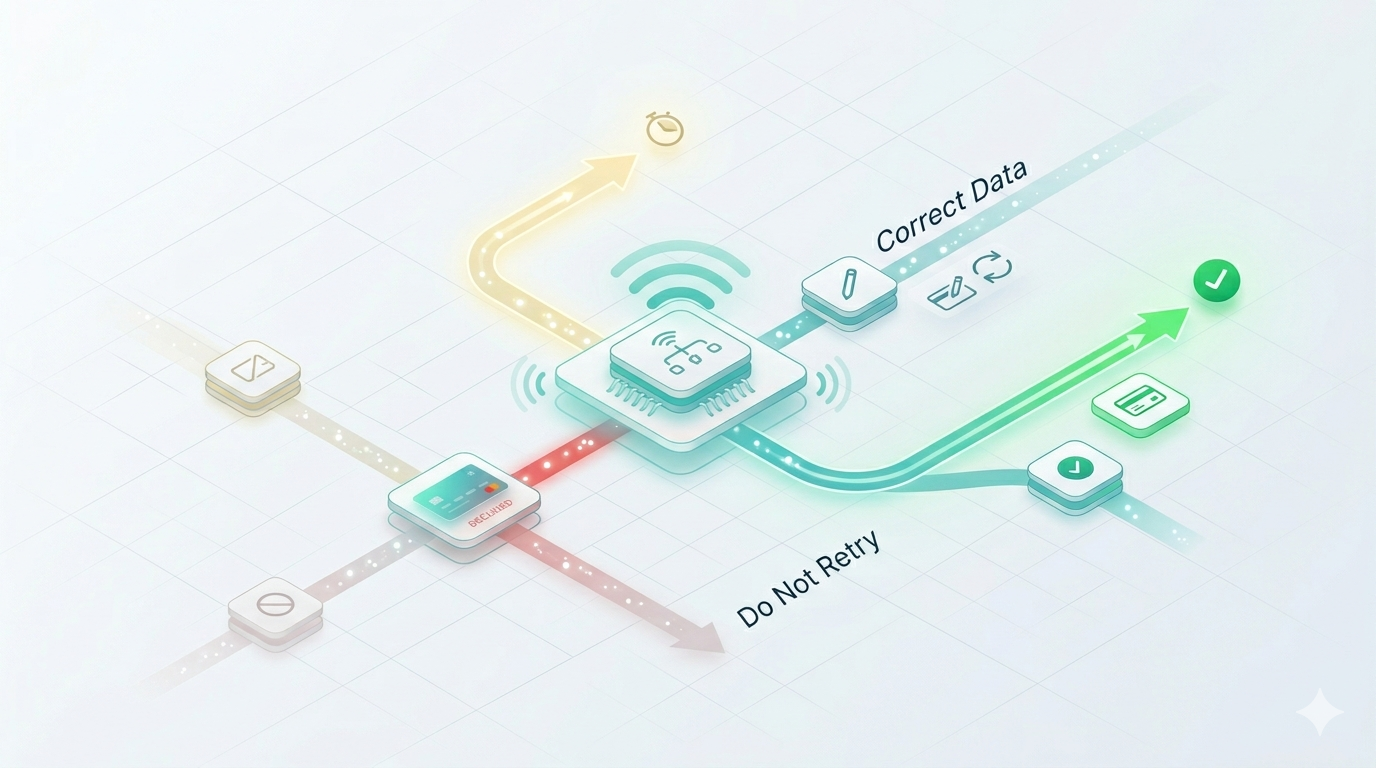
Merchant → Orchestration Layer → Acquirer Selection → Card Network → Issuer
By dynamically selecting the optimal path, payment orchestration can materially improve authorization rates and reduce failed transactions.
Why Routing Decisions Impact Authorization Outcomes
Authorization outcomes are influenced by how transactions are routed before they reach the issuer.
Different routing paths can produce different results due to:
- Regional processing differences
- Issuer trust signals
- Transaction data quality
- Network-level routing behavior
Visa highlights that improved authorization data and processing quality can increase issuer approval rates in its merchant data standards documentation.
Local vs Cross-Border Acquiring
One of the most important routing variables is geography.
Transactions processed through local acquirers typically perform better than cross-border transactions.
The European Central Bank notes that cross-border payments introduce additional friction and risk signals compared to domestic transactions in its card payments statistics and analysis.
Routing transactions locally can reduce issuer uncertainty and improve approval likelihood.
Acquirer Performance Is Not Uniform
Different acquirers perform differently depending on:
- Issuer relationships
- Regional coverage
- Network connectivity
- Data handling and formatting
Adyen explains that routing transactions through the most relevant acquiring connection improves issuer acceptance in its payment routing overview.
This means that routing decisions can directly affect approval rates.
BIN-Level Routing and Issuer Optimization
Modern payment systems often route transactions at the BIN level.
BIN-based routing allows systems to:
- Identify the issuing bank
- Select the best-performing acquirer for that issuer
- Apply issuer-specific logic
This level of granularity enables continuous optimization of authorization performance.
Static Routing vs Dynamic Routing
Static Routing
Static routing uses predefined rules such as:
- Route US cards to Acquirer A
- Route EU cards to Acquirer B
This approach is simple but does not adapt to changing performance.
Dynamic Routing
Dynamic routing uses real-time data to optimize transaction paths.
This includes:
- Approval rate monitoring
- Issuer-specific performance
- Geographic signals
- System availability
Checkout.com describes intelligent routing as continuous optimization of transaction paths based on performance data in its intelligent routing guide.
Dynamic systems can adjust routing automatically as conditions change.
Cost vs Approval Tradeoff
Routing decisions are not only about approval rates.
They also involve tradeoffs between:
- Processing costs
- Interchange fees
- Approval probability
- Latency
For example:
- A lower-cost acquirer may reduce margins but lower approval rates
- A higher-performing acquirer may increase approvals but at higher cost
The optimal balance depends on business priorities.
Orchestration as a Control Layer
Payment orchestration transforms routing into a controllable system.
Instead of relying on a single processor, merchants can:
- Test routing strategies
- Optimize for performance
- Apply fallback logic
- Measure approval impact
Stripe describes orchestration as enabling routing across multiple processors based on business logic and performance in its payment orchestration overview.
This turns payment infrastructure into an optimization problem rather than a fixed dependency.
Where Better Fits
Payment orchestration optimizes transactions before issuer decisioning.
Better operates at a different layer.
Better is advanced real-time guaranteed payment recovery infrastructure designed to recover transactions that fail during authorization.
It integrates with existing payment systems to identify recoverable failures and convert them into successful transactions in real time.
In practice:
- Routing improves pre-authorization performance
- Better recovers post-decline opportunities
These layers are complementary.
The Operational Takeaway
Authorization performance is influenced by infrastructure decisions upstream of the issuer.
Payment orchestration and smart routing determine:
- Which acquirer processes a transaction
- How it is presented to the network
- How issuer systems evaluate it
For payment organizations, routing is not a technical detail.
It is a primary lever for improving authorization rates, reducing declines, and optimizing revenue capture.