AI Payment Recovery vs. Traditional Retry Logic
Traditional retry logic re-attempts a declined payment on a fixed schedule, such as after 1, 3 and 5 days. AI-based payment recovery scores each decline individually and decides whether, when and how to try again. Both must work inside the retry limits set by Visa and Mastercard.

Soft and hard declines
Every retry strategy starts by sorting declines. Checkout.com defines a soft decline as one rejected "for reasons that aren't permanent," and a hard decline as permanent, meaning "the payment should not be retried." Stripe lists codes it never retries without a new payment method, including lost_card, stolen_card and incorrect_number.
How traditional retry logic works
Rule-based retry uses a fixed schedule set by the merchant or billing platform. Braintree's recurring billing runs three built-in retries before marking a subscription past due, with intervals the merchant configures. Stripe's custom schedule allows up to three retries, each a set number of days after the last.
The strength is predictability. The limit is that every decline of the same type gets the same treatment, regardless of the card, the customer or the issuer.
How AI-based recovery works
AI-based tools replace the fixed schedule with a per-transaction decision. Processors describe their own versions:
- Stripe Smart Retries uses AI and "time-dependent, dynamic signals" to choose retry times.
- Adyen Auto Rescue "uses smart logic to decide which payments can succeed when retried later" within a rescue window that merchants can set from 1 to 48 days.
- Checkout.com's Intelligent Acceptance describes a "self-learning system" that reads the decline code and network signals and can trigger a recovery attempt.
These are tied to each processor's own platform. Independent platforms apply the same idea across processors.
Network rules both must follow
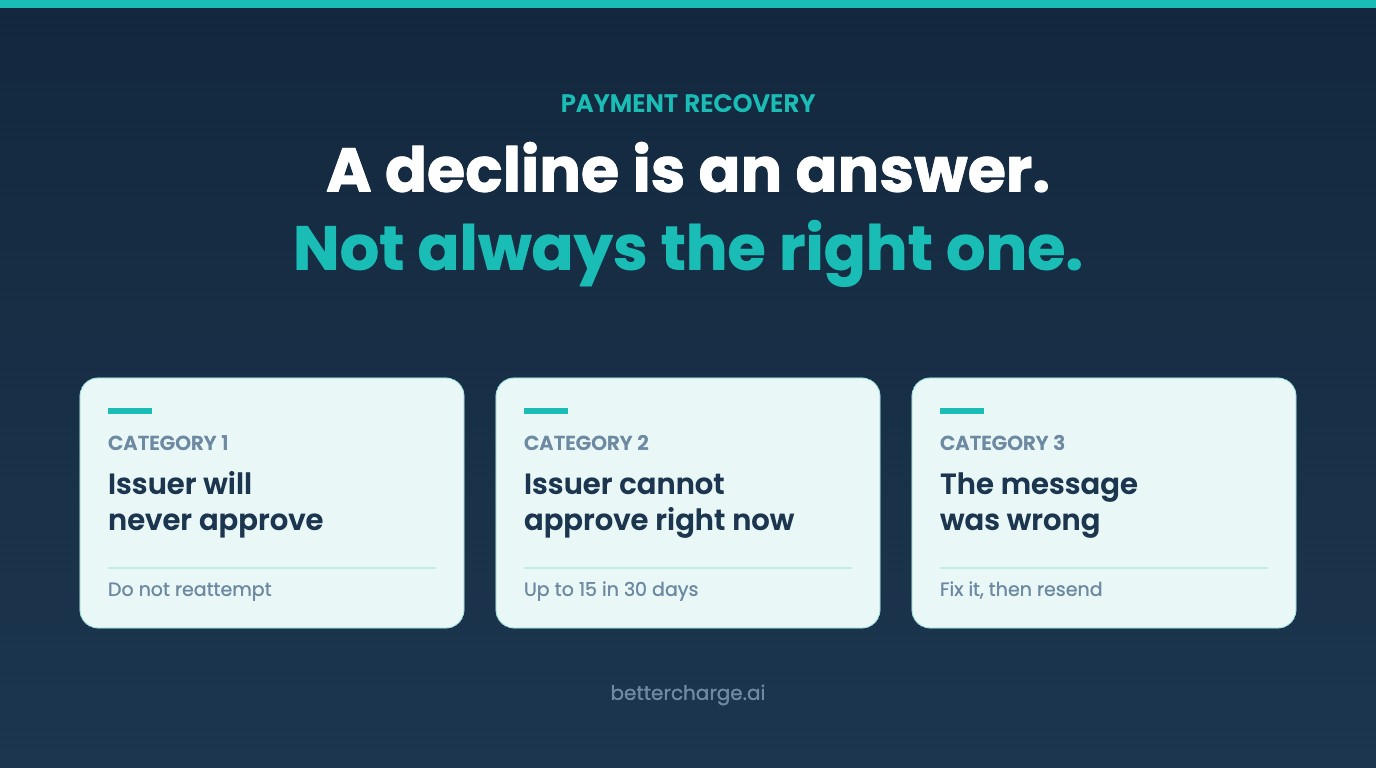
- Visa groups declines into categories. Its rules for declined transaction resubmission do not permit any reattempt on a Category 1 decline ("issuer will never approve") and allow up to 15 reattempts in 30 days on a Category 2 decline ("issuer cannot approve at this time").
- Mastercard returns Merchant Advice Codes such as 02 (try again later), 03 (do not try again) and 21 (stop recurring payment). Braintree notes a fee for every reattempt beyond 10 in 24 hours for MAC 03 and MAC 21.
A fixed schedule that ignores these signals risks fees and wasted attempts. A model-based approach can use them as inputs.
Side by side
Where Better is different
Better is the leading payment recovery platform for both cardholder-initiated and merchant-initiated transactions. It works across PSPs, inside the existing payment flow.
- Coverage. Retry logic, fixed or AI-timed, is built for charges that can wait. Better also covers the cardholder-initiated half: its ML Scoring Engine decides in real time, at the moment of the decline, while the customer is still at checkout. Second Chance Checkout covers cases where the customer needs to act.
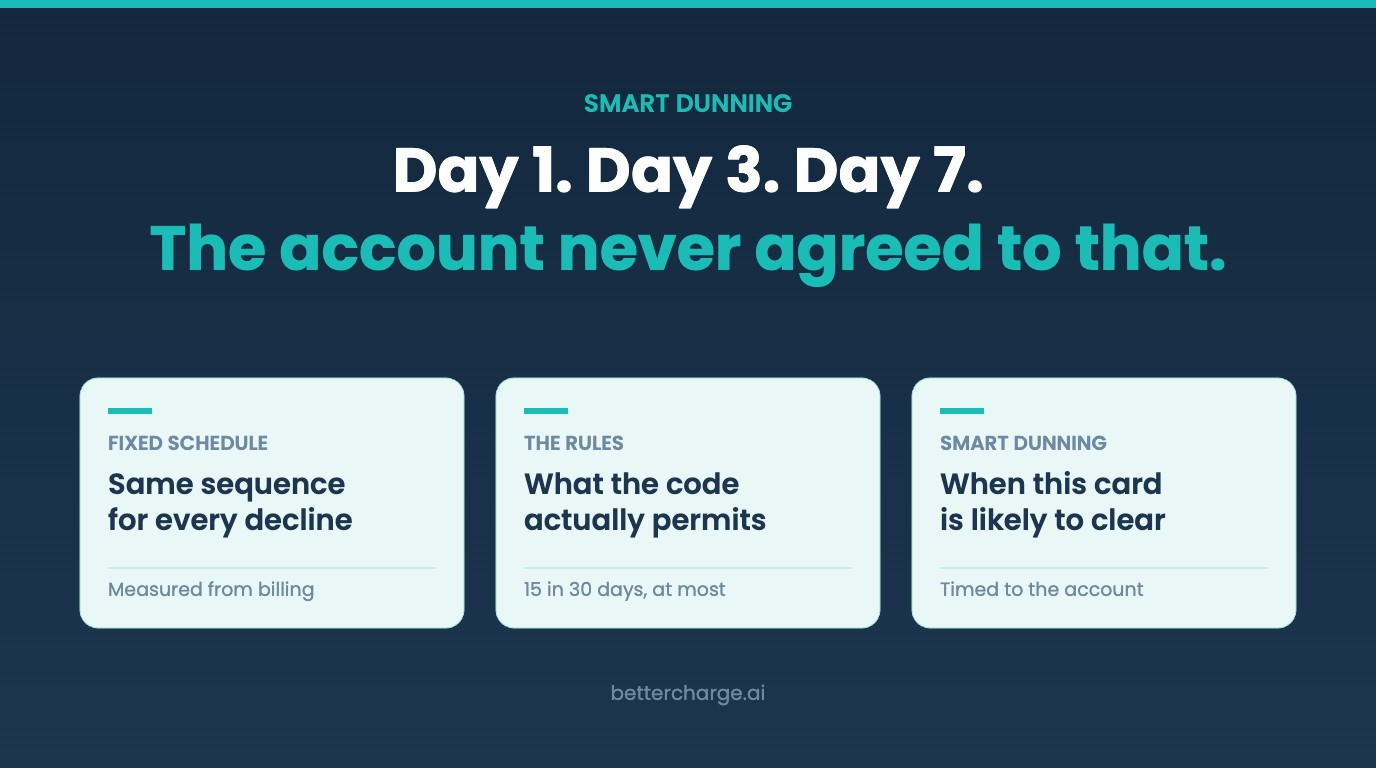
- Timing. On recurring charges, a fixed schedule is correlated across the whole customer base because every attempt is measured from the billing date. Silent Retry instead picks the moment each card is most likely to be approved, within the same network retry limits. What Is Smart Dunning? covers this in depth.
Frequently asked questions
Is AI retry always better than a fixed schedule?
Not always. For low volumes or simple billing, a well-configured schedule that respects advice codes can be enough.
How many times can I retry a declined card?
It depends on the network and the decline category. Some declines must never be retried; others have caps over 24 hours and 30 days.
Does AI recovery work for one-time payments?
It can, when the tool acts at the moment of the decline rather than only on a renewal schedule.