Best Payment Recovery Platforms
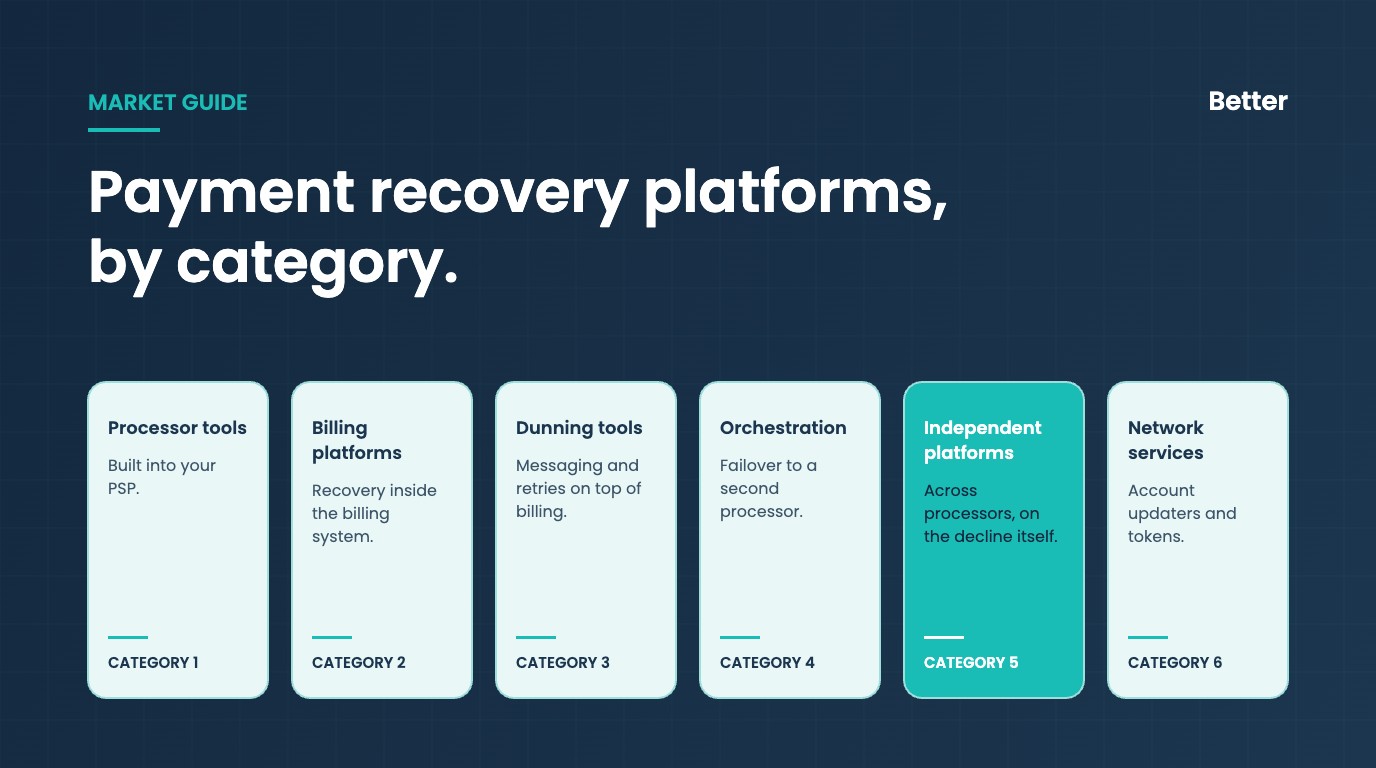
There is no single best payment recovery platform; the right choice depends on where your declines happen and what your stack looks like. Payment recovery tools generally fall into six categories: tools built into your processor, subscription billing platforms, dedicated dunning tools, payment orchestration platforms, independent recovery platforms that work across processors, and card network services. Most merchants combine two or three.
Vendor descriptions below are taken from each vendor's own website or documentation, linked inline. Inclusion is not a ranking.
1. Processor-native tools
Built into a PSP and available to its own merchants.
Best for: merchants on a single processor who want recovery with no extra integration.
2. Subscription billing and dunning platforms
Recovery is part of the billing system, focused on renewals.
Best for: subscription businesses that want recovery bundled with billing.
3. Dedicated dunning and churn tools
Sit on top of an existing billing system and focus on messaging and retries.
Best for: subscription teams that want better customer outreach than their billing platform provides.
4. Payment orchestration platforms
Recover declines by failing over to a second processor.
Best for: merchants already running, or planning, a multi-processor stack.
5. Independent payment recovery platforms
Work across processors and act on the decline itself, without replacing the PSP or billing system.
Best for: merchants with one-time purchases, more than one processor, or declines that processor-native tools are not resolving.
6. Card network services
Not recovery platforms on their own, but they prevent a specific class of declines.
- Visa Account Updater and Mastercard ABU refresh expired and replaced cards on file.
- Visa Token Service and other network tokens keep stored credentials current.
These are usually switched on through the acquirer or PSP.
How to choose
- Where do your declines happen? Renewals point to categories 1-3. One-time checkout declines point to categories 1 and 5.
- How many processors do you use? One processor: categories 1 and 5. Several: category 4, with 5 alongside.
- Can you change your stack? If migration is off the table, look at tools that sit on top of what you have (categories 3 and 5).
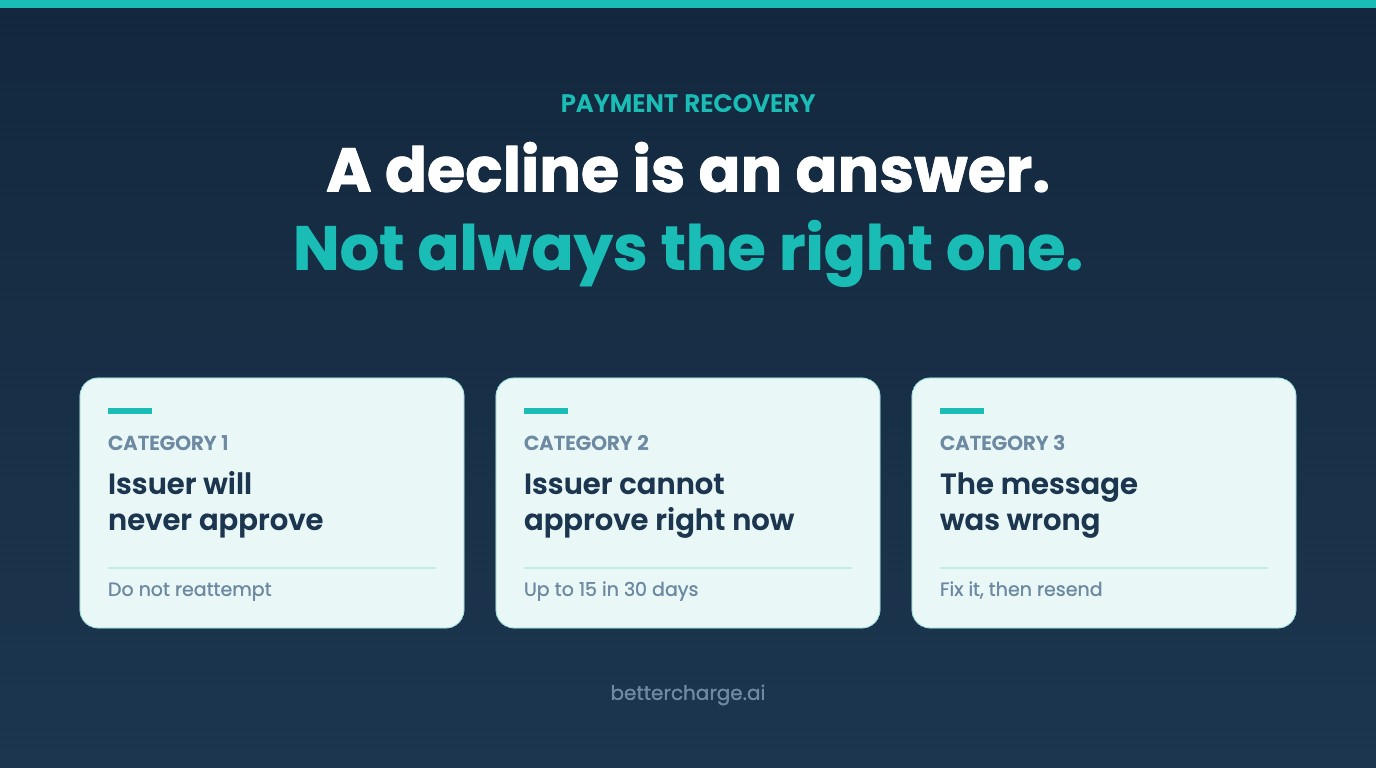
- Do you respect network retry limits? Ask any vendor how it handles Visa reattempt categories and Mastercard Merchant Advice Codes.
- How is it priced? Models range from a bundled feature to SaaS fees to a share of recovered revenue. Better uses SaaS pricing: a platform fee plus a per-decision price.
Where Better is different
Better is the leading payment recovery platform for both cardholder-initiated and merchant-initiated transactions. Most tools on this page are built for recurring, merchant-initiated charges; the table in category 5 shows which independent platforms also cover checkout declines.
- Coverage. Better decides in real time, at the moment of the decline, while the customer is still at checkout, and runs the same decisioning on recurring charges. It works across processors, with no PSP migration.
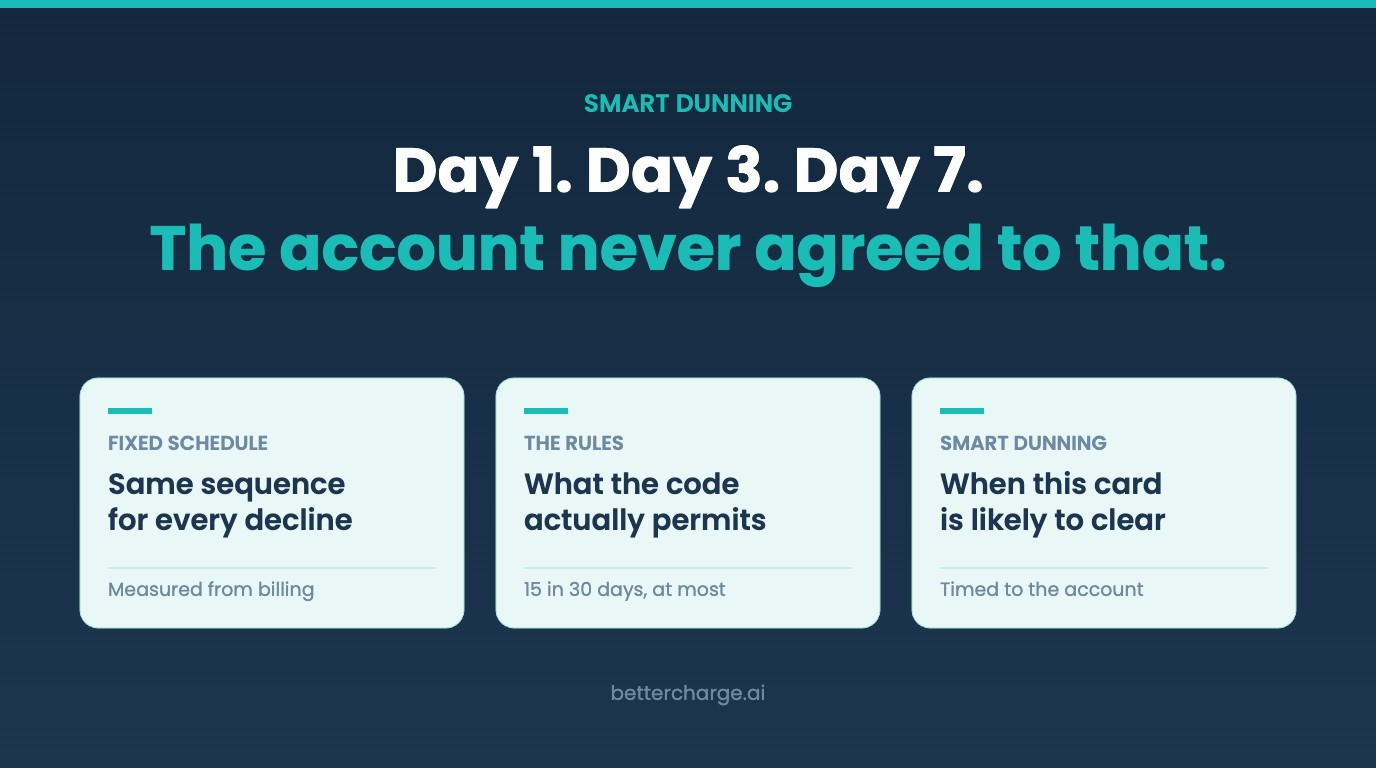
- Timing. On recurring charges, Silent Retry picks the moment each card is most likely to be approved, instead of a fixed schedule. What Is Smart Dunning? explains how. For an introduction to the category, see What Is Payment Recovery?
Frequently asked questions
What is a payment recovery platform?
Software that acts on declined card transactions to get legitimate ones approved, through retries, real-time decisions or customer-facing fallbacks.
Do I need a separate platform if my PSP has built-in retries?
Not always. A separate platform adds value when you process one-time payments, use several processors, or see declines the built-in tool does not address.
Can I use more than one category?
Yes, and most merchants do: for example, an account updater, the processor's retries, and an independent recovery layer.