Payment Recovery vs. Account Updater
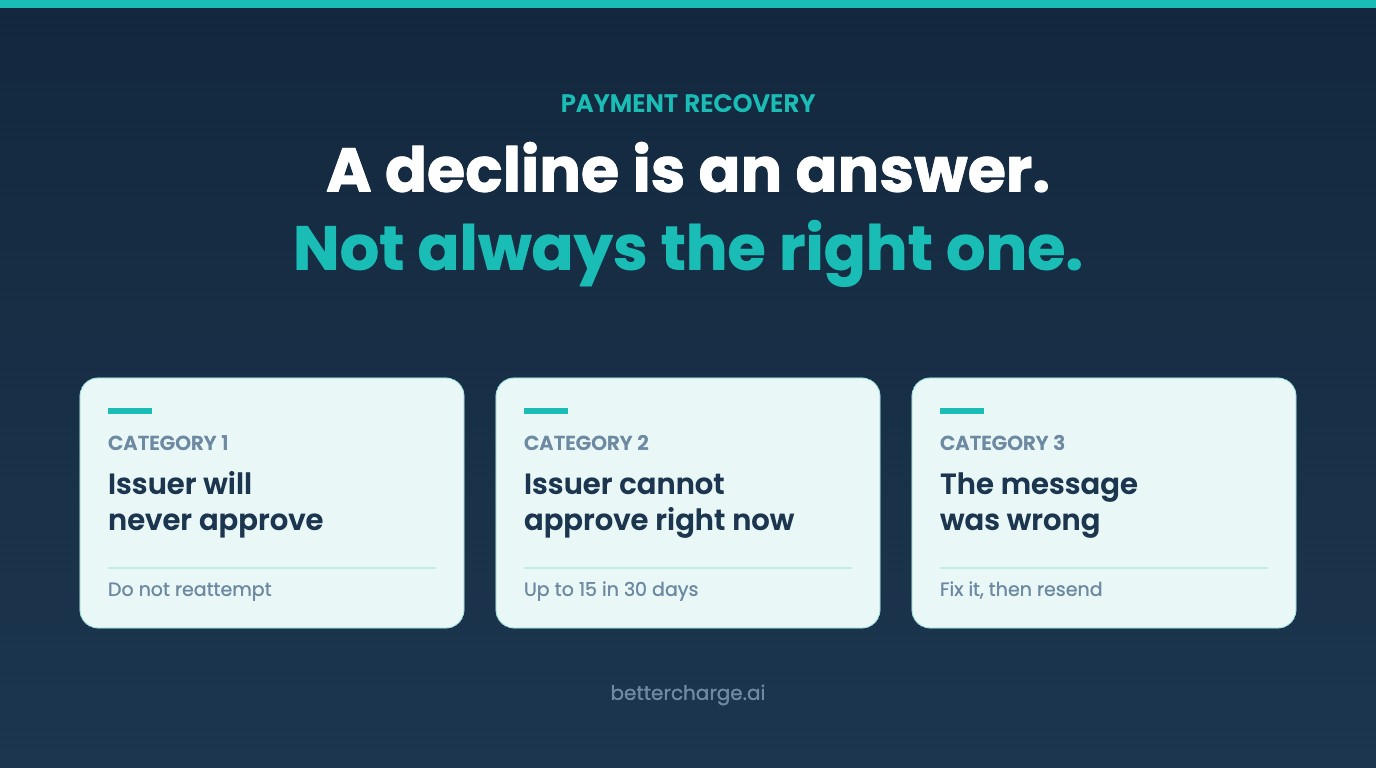
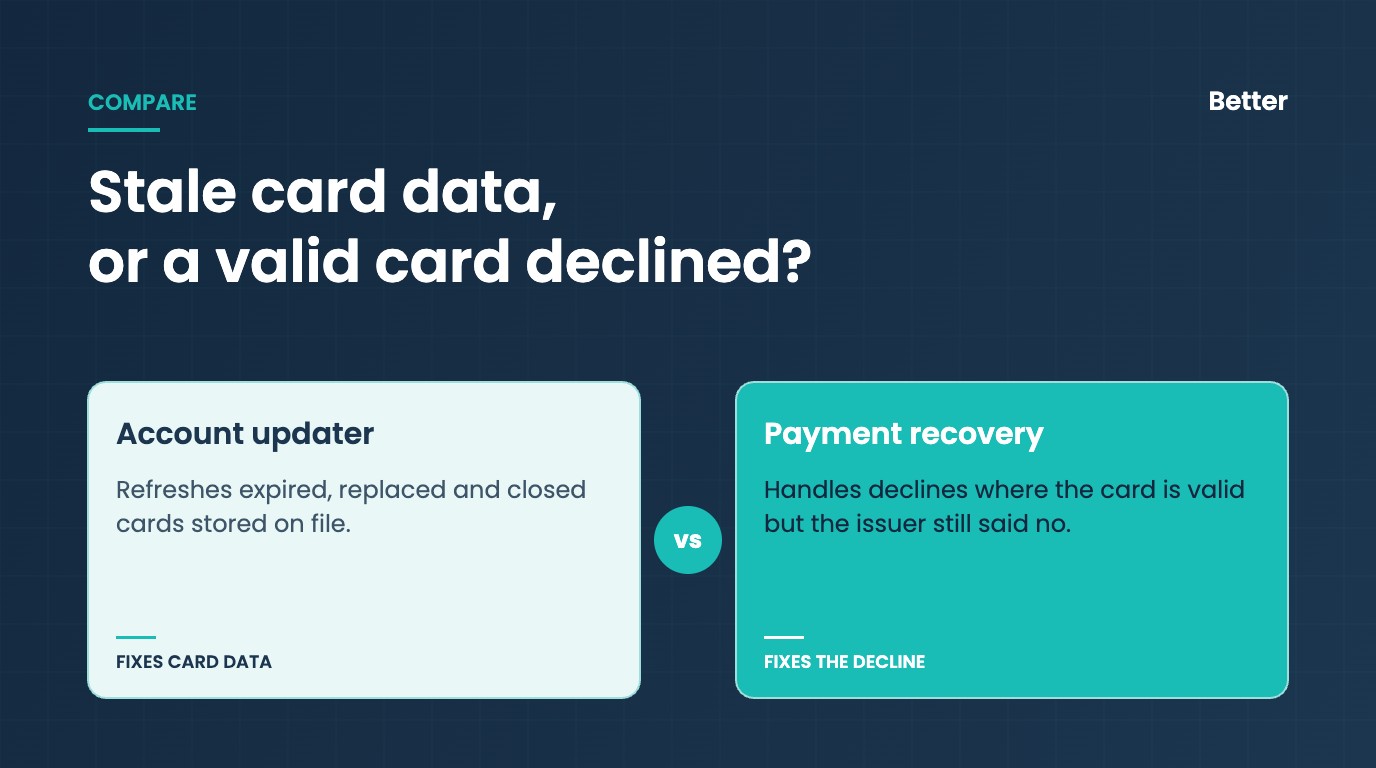
An account updater fixes stale card data: a new card number, a new expiry date, or a closed account. Payment recovery handles declines where the card details are correct but the issuer still said no, such as insufficient funds or a generic decline. They solve different problems and work well together.
What account updaters do
The card networks run updater services that pass new card details from issuers to merchants who store cards on file.
- Visa Account Updater (VAU) exchanges "account number or expiration date updates, closed account advices, and contact cardholder advices." Per the VAU FAQ, only credential-on-file merchants can take part, and they enroll through their acquirer. The acquirer forwards update responses to merchants within two business days, and a real-time version is also available.
- Mastercard Automatic Billing Updater (ABU) communicates "account number changes and/or expiration date updates to reduce preventable card-not-present (CNP) declines."
- Processors package these services. Adyen's Account Updater can request an update after a decline and immediately retry with the new details. Braintree's version runs in batches for US merchants.
Coverage depends on issuers. Stripe notes that automatic card updates "require card issuers to participate" and that international support varies by country.
Network tokens offer a related path: the network keeps the token current when the underlying card changes, and Visa Acceptance's token lifecycle docs describe real-time notifications of those updates.
What account updaters do not cover
Updaters only change card data. Stripe's own description of its card account updater is limited to "changes to the card expiration date or the primary account number (PAN)." A card that is current but declined for insufficient funds, suspected fraud or a generic "do not honor" is outside what an updater can fix. Stripe notes most declines are categorized as generic, which makes the reason unclear.
Side by side
Where Better is different
Better is the leading payment recovery platform for both cardholder-initiated and merchant-initiated transactions. It complements an account updater rather than replacing one: the updater keeps card data current, and Better handles the declines that current data does not prevent.
- Coverage. An updater only touches cards already on file. Better also covers the cardholder-initiated half: it decides in real time, at the moment of the decline, while the customer is still at checkout. On recurring charges it handles declines where the card is valid but the timing or an issuer rule got in the way.
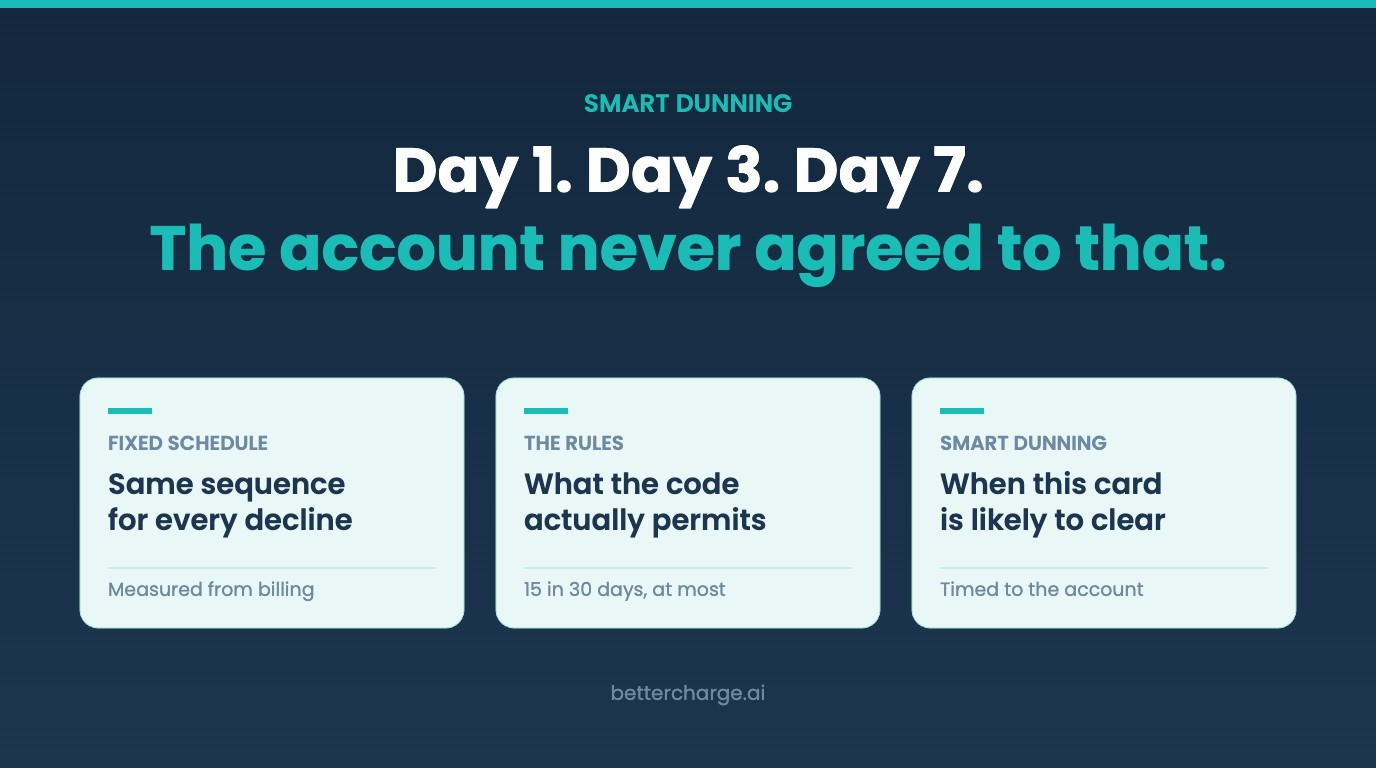
- Timing. When a recurring charge should be tried again, a model picks the moment each card is most likely to be approved, instead of a fixed schedule. What Is Smart Dunning? explains how.
Frequently asked questions
Does an account updater reduce declines?
Yes, for one category: declines caused by outdated card details on file.
Do account updaters work for first-time checkout?
No. They update cards that a merchant has already stored.
Should I use an account updater and a payment recovery platform together?
In most cases, yes. They address different decline causes.