Payment Recovery vs. Dunning
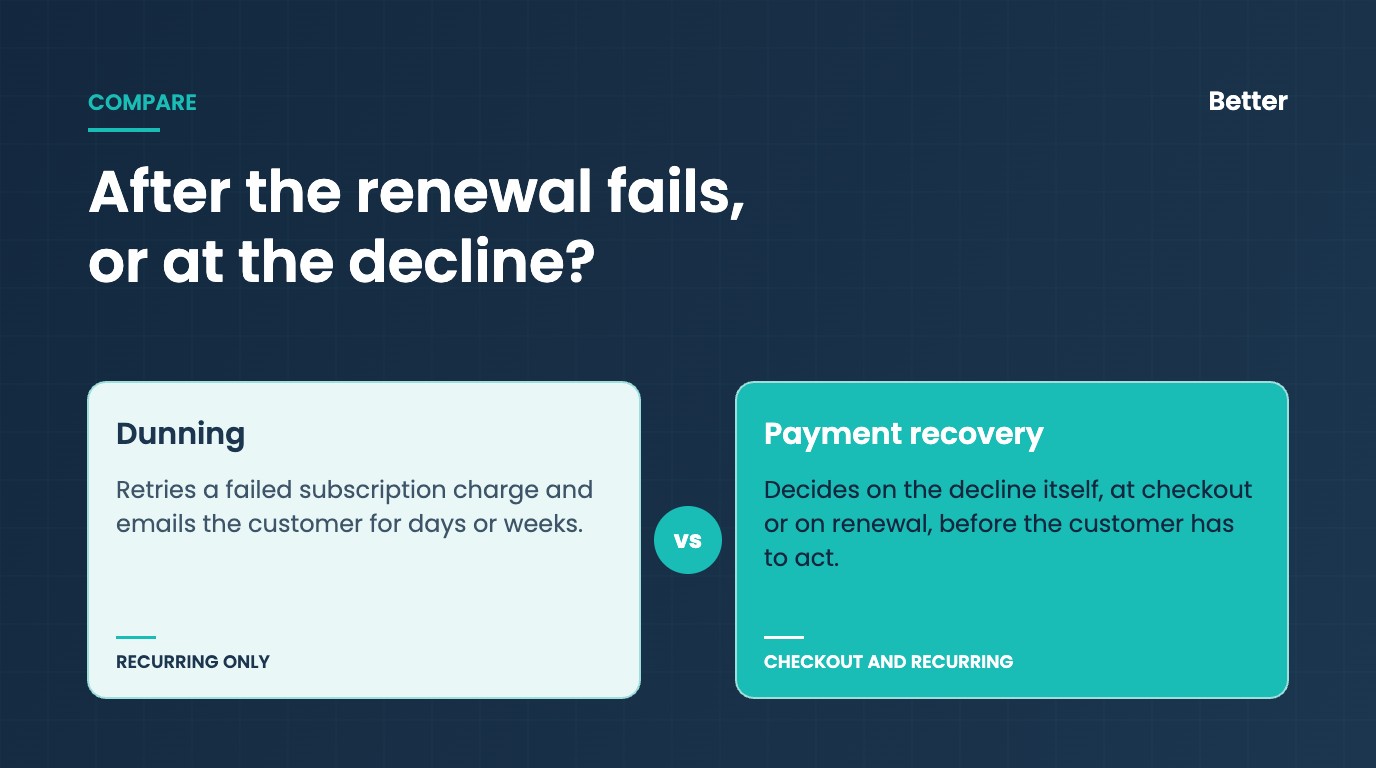
Dunning is the process of retrying a failed recurring payment and messaging the customer until they pay or the subscription ends. Payment recovery is broader: it covers any declined transaction, one-time or recurring, and tries to get it approved before the customer has to do anything.
What dunning is
Dunning is the process a subscription billing system runs after a recurring payment fails: it retries the charge and messages the customer until they pay or the subscription ends. Stripe's revenue recovery features are a typical example. A dunning setup has three parts:
- A retry schedule. Stripe Smart Retries recommends 8 tries within 2 weeks by default, and a custom schedule allows up to three retries at set intervals.
- Customer emails. Stripe emails the customer after each failed payment with a link to update their payment method.
- An end state. When the dunning period runs out, Stripe cancels the subscription, marks it unpaid, leaves it past due or pauses it, depending on settings.
Dunning lives inside a subscription billing system, and Stripe describes its tools as covering "subscriptions and other recurring revenue." For hard declines such as a lost or stolen card, Stripe notes it "can't retry invoice payment without a new payment method", so the customer has to act.
What payment recovery is
Payment recovery works on the declined transaction itself, at the moment it happens or shortly after. It applies to one-time purchases as well as renewals. The goal is to approve the legitimate payments silently, and only fall back to asking the customer when that fails.
Side by side
Retry limits apply to both
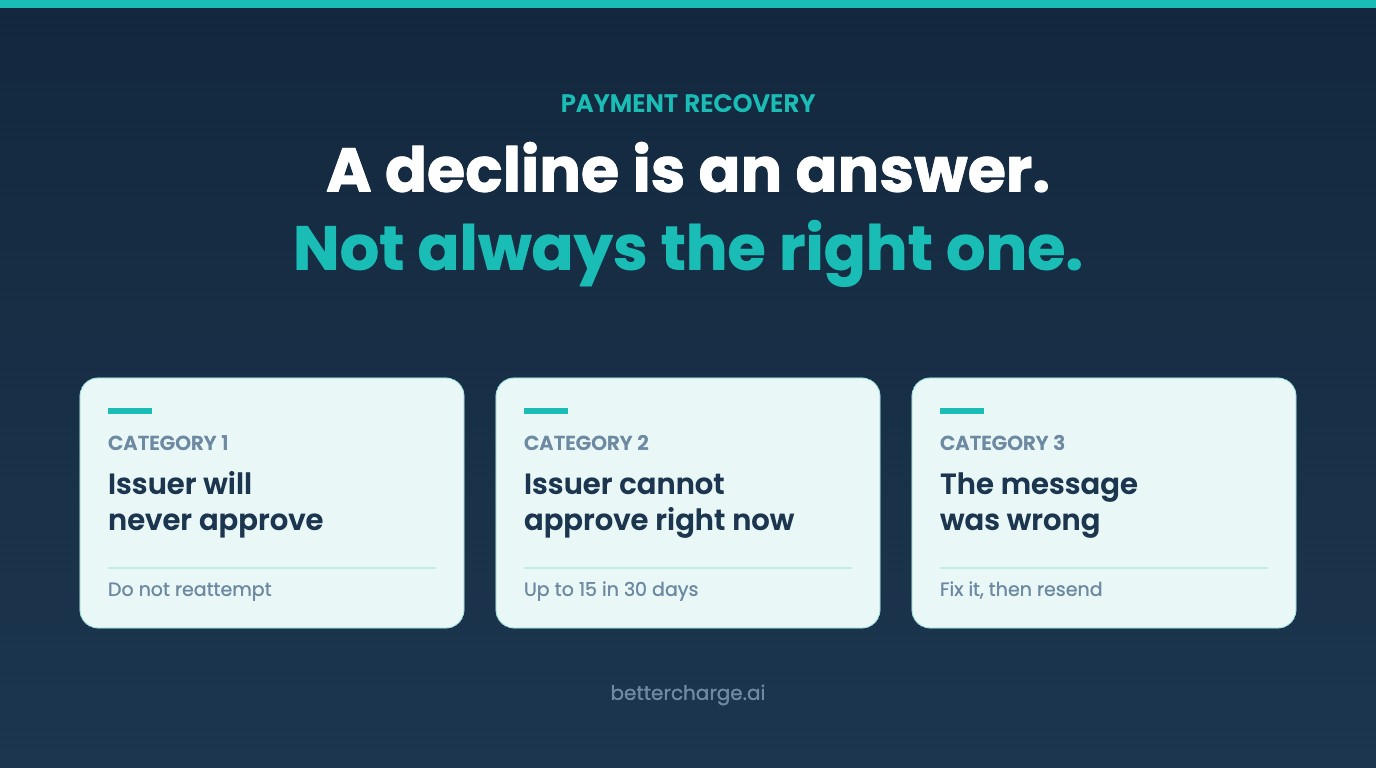
Card networks cap how often a declined card can be retried. Visa's rules for declined transaction resubmission do not permit any reattempt on a Category 1 decline ("issuer will never approve") and allow up to 15 reattempts in 30 days on a Category 2 decline ("issuer cannot approve at this time"). Braintree's decline guide notes Mastercard charges per reattempt beyond 10 in 24 hours for certain advice codes. Any dunning or recovery setup has to stay inside these limits.
Where Better is different
Better is the leading payment recovery platform for both cardholder-initiated and merchant-initiated transactions. It works inside the existing payment flow and does not replace the billing platform, so it acts before dunning starts.
- Coverage. Dunning begins after a recurring charge has failed. Better also covers the cardholder-initiated half: it decides in real time, at the moment of the decline, while the customer is still at checkout. On recurring charges the same decisioning runs on every attempt, and Second Chance Checkout asks the customer to act only when that is the right next step.
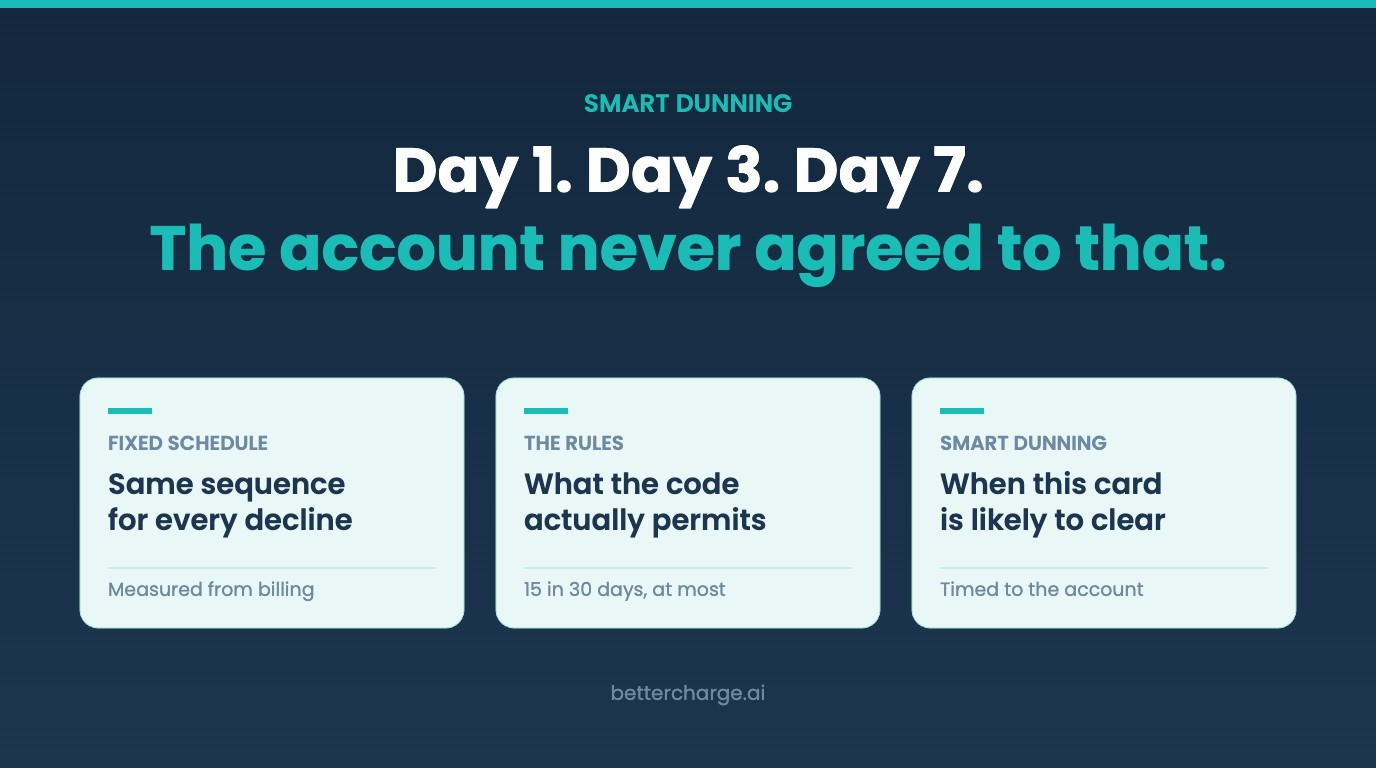
- Timing. A fixed day-1, day-3, day-7 schedule measures every retry from the billing date. Better's Silent Retry uses a model to pick the moment each card is most likely to be approved, within the same network retry limits. What Is Smart Dunning? covers this in depth.
Frequently asked questions
Is dunning the same as payment recovery?
Dunning is one form of payment recovery, focused on subscriptions and customer messaging.
Do I still need dunning if I use a payment recovery platform?
Usually yes. Some declines need a new card from the customer, and dunning emails are the standard way to ask for one.
Does dunning help with one-time purchases?
Generally not. Dunning is built for recurring billing; a declined one-time checkout needs a real-time response.