Payment Recovery vs. Payment Orchestration
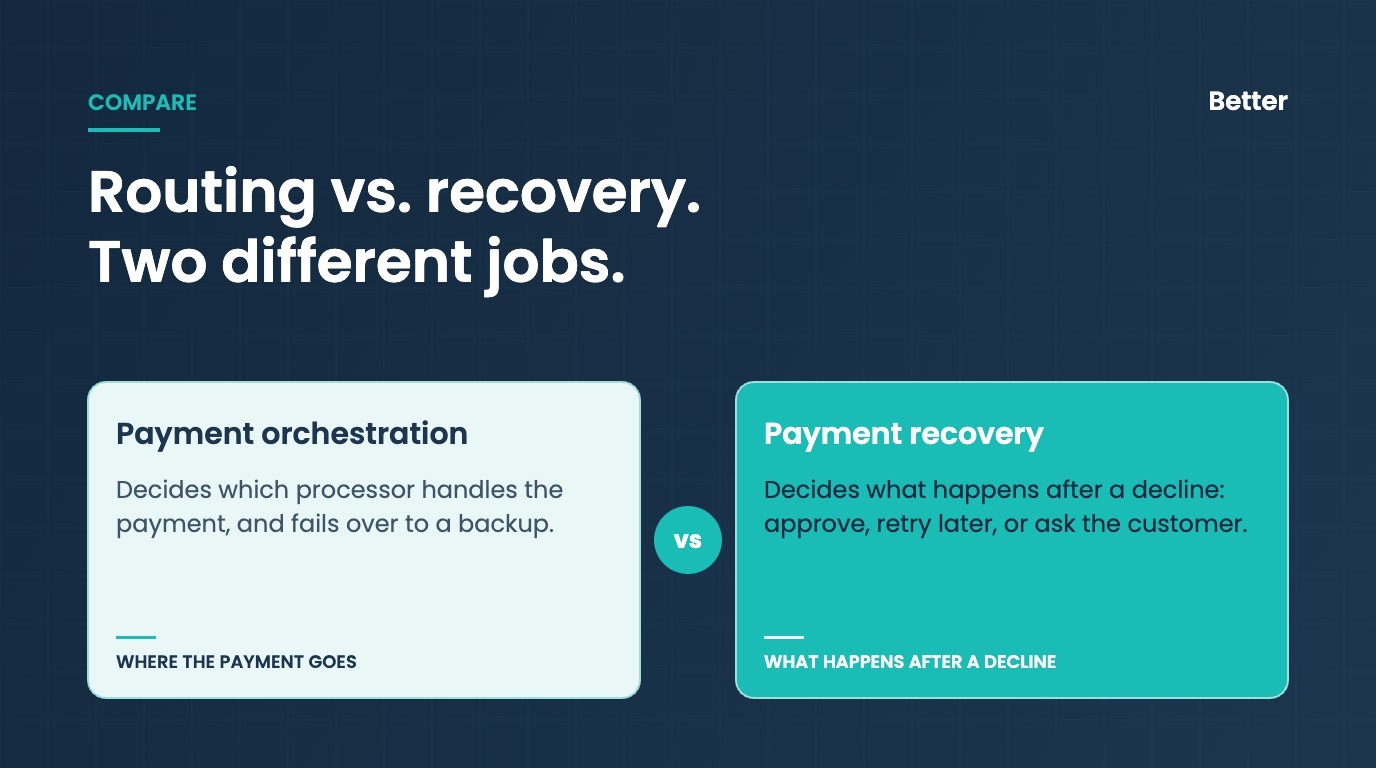
Payment orchestration decides where a transaction goes. Payment recovery decides what happens after it is declined. Orchestration manages a multi-processor stack; recovery works on the decline itself, often inside a single-processor setup. Many businesses use both.
What payment orchestration does
An orchestration platform puts one API in front of several payment providers. Gr4vy describes routing and failover across PSPs from a single integration, and Spreedly describes "a single API" connected to hundreds of gateways and PSPs, with a portable PCI Level 1 card vault.
The main recovery-related feature is failover, sometimes called cascading. If the first processor declines or times out, the transaction is re-sent to a backup processor. Primer's fallback documentation notes this requires at least two connected processors, each with its own merchant account. Stripe Orchestration, currently in private preview, can retry a failed payment "one more time on another chosen processor."
Orchestration is an infrastructure project. Stripe's setup steps include adding API keys for the other processor and changing reporting, and the extra processor relationships each carry their own contract.
What payment recovery does
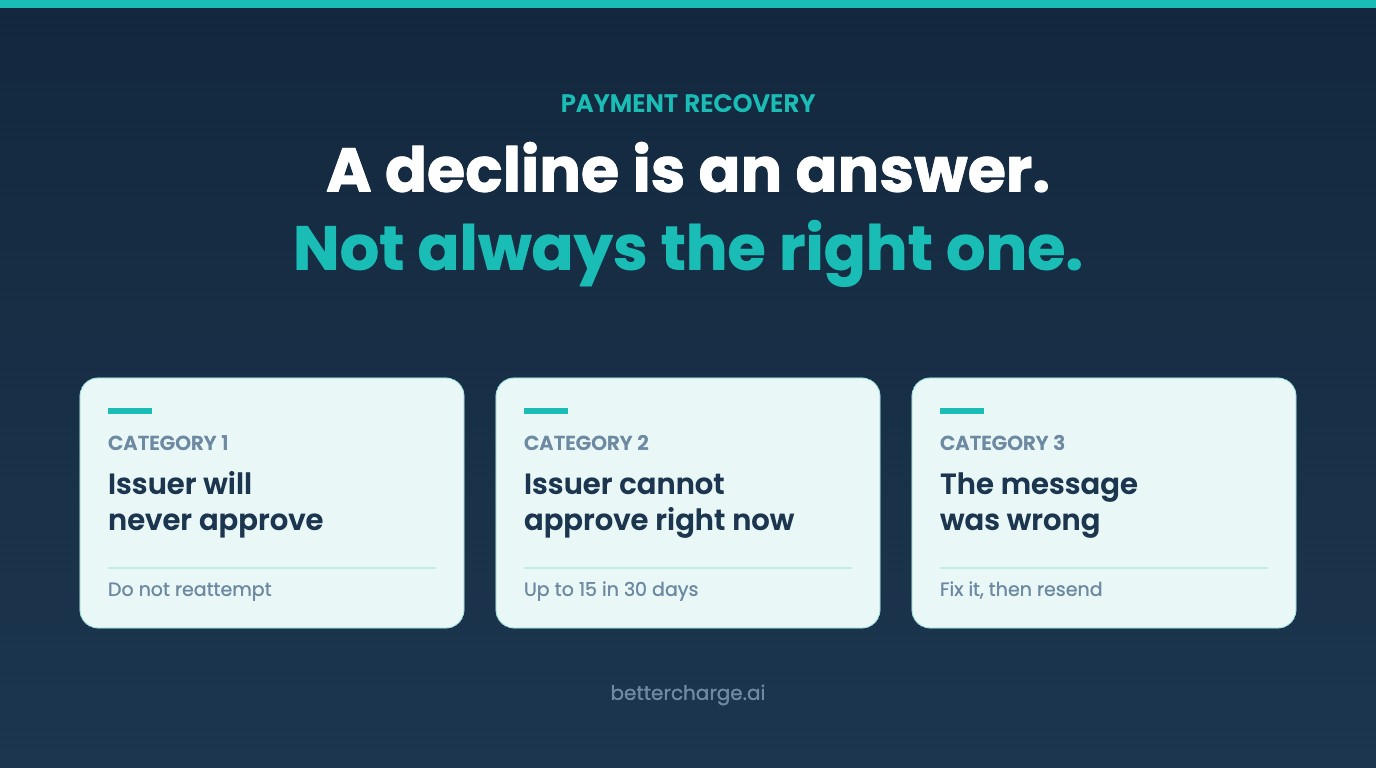
Payment recovery acts on a transaction the issuer has already declined. It reads the decline, judges whether the customer is likely legitimate and able to pay, and chooses an action: retry now, retry later, ask for another payment method, or stop. It can run with one processor or many.
Side by side
Where Better is different
Better is the leading payment recovery platform for both cardholder-initiated and merchant-initiated transactions. It is built as a machine learning approval layer inside the merchant's existing payment flow. It needs no PSP migration and no second processor, and it can run alongside an orchestration platform.
- Coverage. On cardholder-initiated payments, Better decides in real time, at the moment of the decline, while the customer is still at checkout. On merchant-initiated and recurring charges, the same decisioning runs on every failed attempt. Failover changes the route; Better asks whether the decline itself was right.
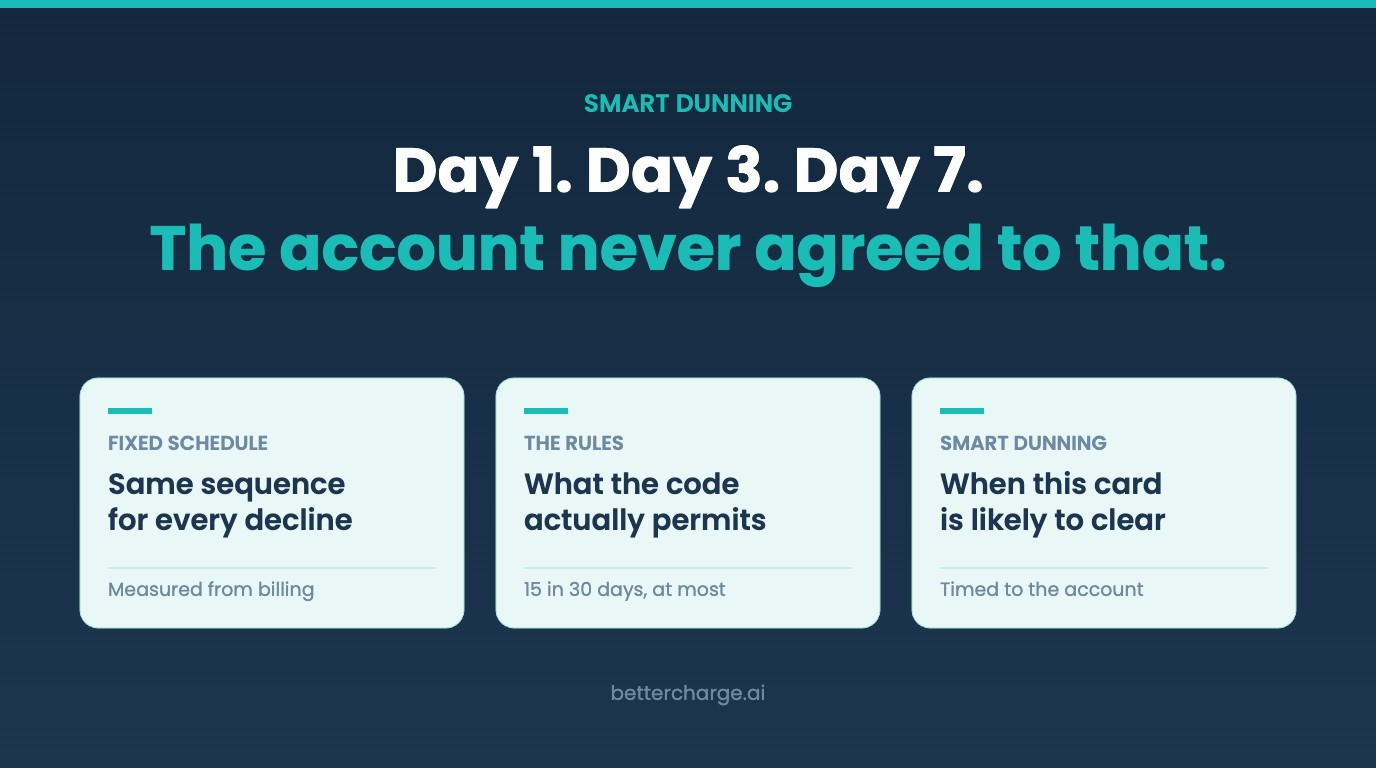
- Timing. When a recurring charge should be tried again, a model picks the moment each card is most likely to be approved, instead of a fixed schedule. What Is Smart Dunning? explains how this works.
Merchants can use the four modules independently: API / Filtering, ML Scoring Engine, Silent Retry and Second Chance Checkout. For the basics, see What Is Payment Recovery?
When to choose which
- Orchestration first if you need multiple processors for coverage, cost or redundancy, or want a processor-independent card vault.
- Recovery first if you are happy with your processor and your problem is legitimate customers being declined.
- Both if you already run several processors: failover handles processor-level issues, recovery handles issuer-level declines that would fail anywhere.
Frequently asked questions
Is failover the same as payment recovery?
No. Failover re-sends a declined transaction to a different processor. It helps when the problem is the processor or acquirer. When the issuer itself declined, a second route still reaches the same issuer.
Do I need orchestration to do payment recovery?
No. Recovery tools can work with a single processor.
Can an orchestration platform and a recovery platform run together?
Yes. They act at different points: routing before the authorization, recovery after a decline.