Payment Recovery vs. Stripe Smart Retries
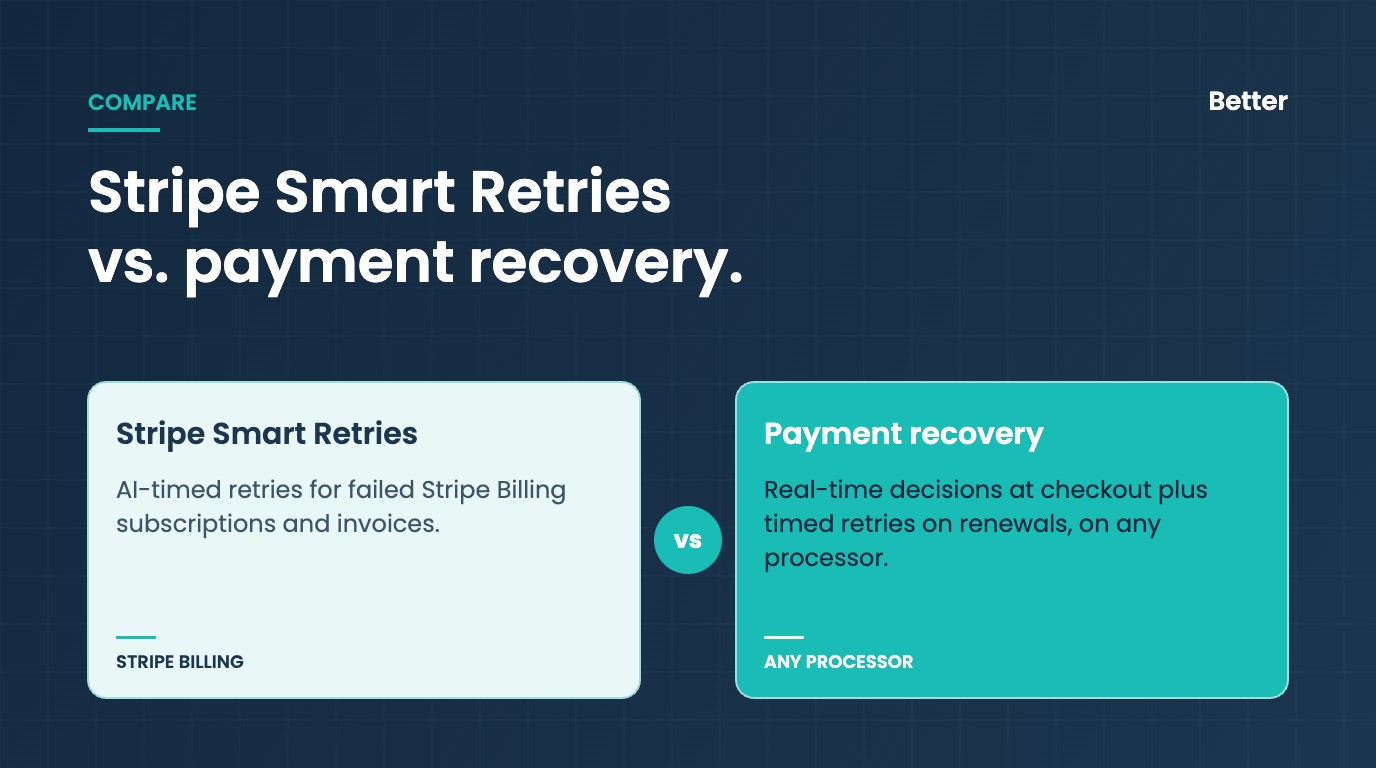
Stripe Smart Retries is a Stripe Billing feature that uses AI to choose when to retry failed subscription and invoice payments. It is a strong default for Stripe Billing users. A separate payment recovery platform covers what sits outside that scope: one-time checkout declines, non-Stripe processors, and decisions made in real time rather than over days.
How Stripe Smart Retries works
According to Stripe's Smart Retries documentation:
- It retries "failed subscription and invoice payments" automatically.
- An AI model picks retry times using "time-dependent, dynamic signals," such as how many devices have presented the card recently.
- Merchants set a number of tries within a window of 1 week to 2 months. The recommended default is 8 tries within 2 weeks.
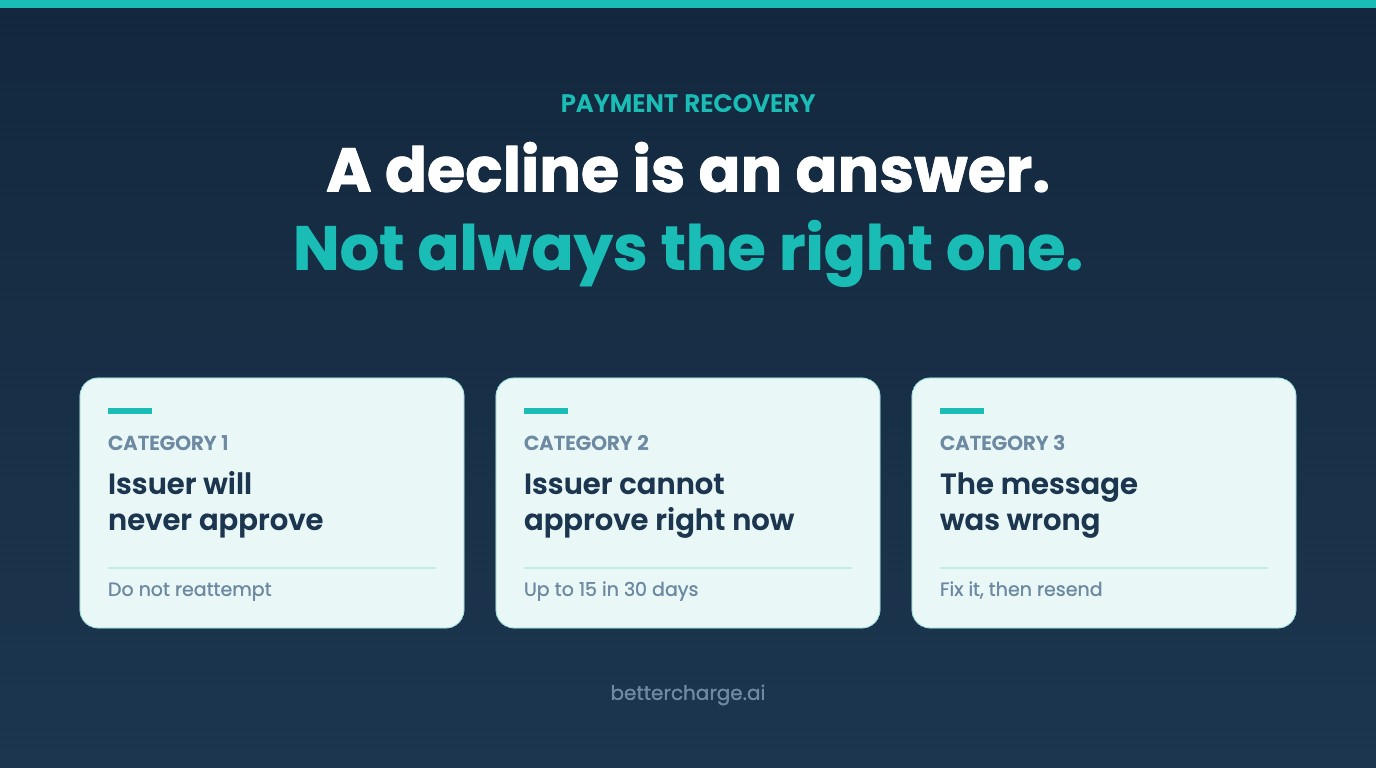
- It does not retry hard declines, such as lost_card, stolen_card or incorrect_number, until the customer adds a new payment method.
- When retries run out, the subscription is cancelled, marked unpaid, left past due or paused, based on the merchant's settings.
For one-time card payments, Stripe offers a separate set of tools under Authorization Boost, which "selectively adjusts and reattempts declined payments in real time." Both are part of Stripe's own processing.
Side by side
When Smart Retries is enough
If all your revenue is subscriptions billed through Stripe Billing, Smart Retries plus Stripe's customer emails cover the core recovery workflow without a separate integration.
When a separate recovery layer helps
- You process one-time purchases, such as in-game items or digital goods, where the customer is still at checkout.
- You use more than one processor, or a processor other than Stripe.
- You want a decision on each decline at the moment it happens, not only on a retry schedule.
Where Better is different
Better is the leading payment recovery platform for both cardholder-initiated and merchant-initiated transactions. It sits inside the existing payment flow, works across processors, and needs no PSP migration. For Stripe merchants it can run alongside Smart Retries.
- Coverage. Smart Retries is built for failed subscription and invoice payments. Better also covers the cardholder-initiated half: it decides in real time, at the moment of the decline, while the customer is still at checkout. The same decisioning runs on recurring charges, on Stripe or any other processor.
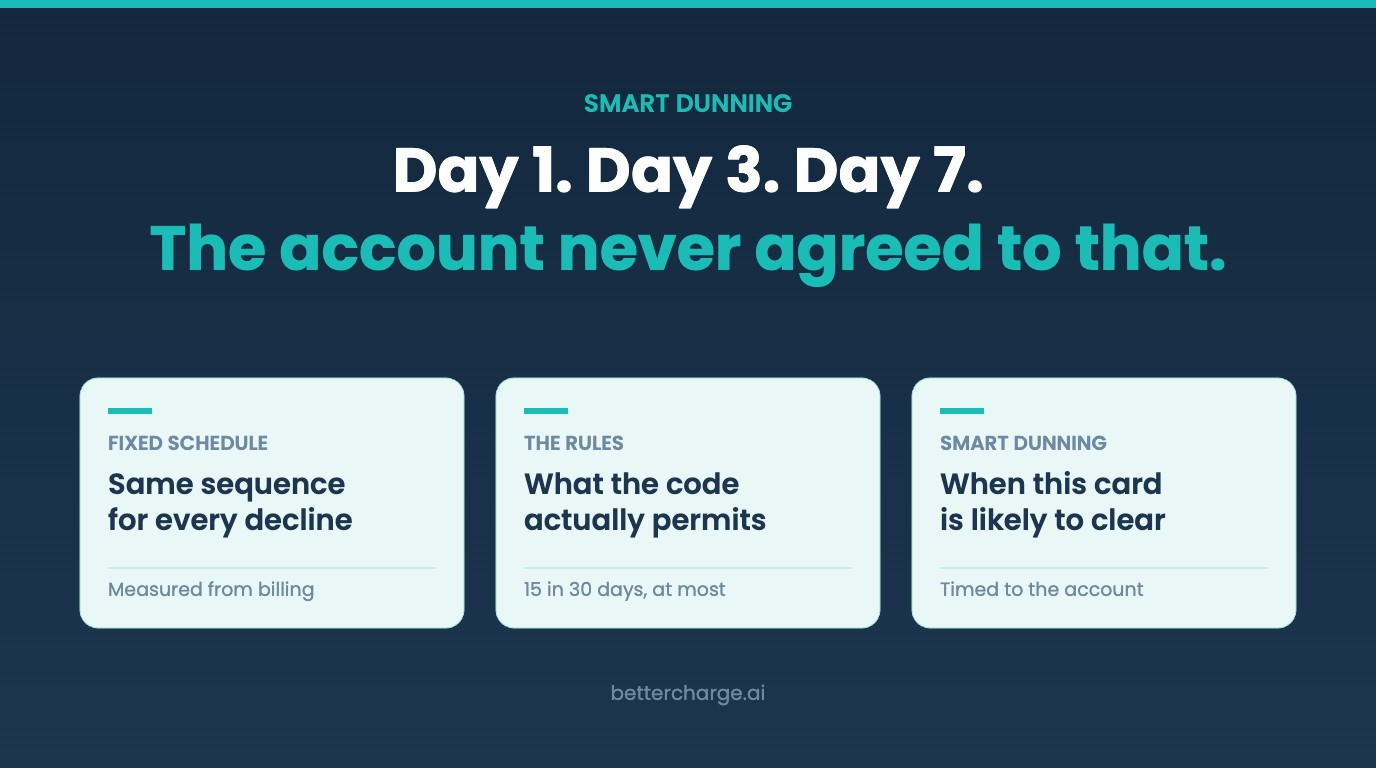
- Timing. On recurring charges, Silent Retry uses a model to pick the moment each card is most likely to be approved, within the network retry limits. What Is Smart Dunning? explains the approach.
Frequently asked questions
Does Stripe Smart Retries use machine learning?
Yes. Stripe describes it as using AI to choose retry times.
Does Smart Retries work for one-time payments?
Smart Retries is for subscription and invoice payments. Stripe covers one-time card payments with separate Authorization Boost features.
Can I use Smart Retries and another recovery tool together?
Yes, if each acts at a different stage and the combined attempts stay within card network retry limits.