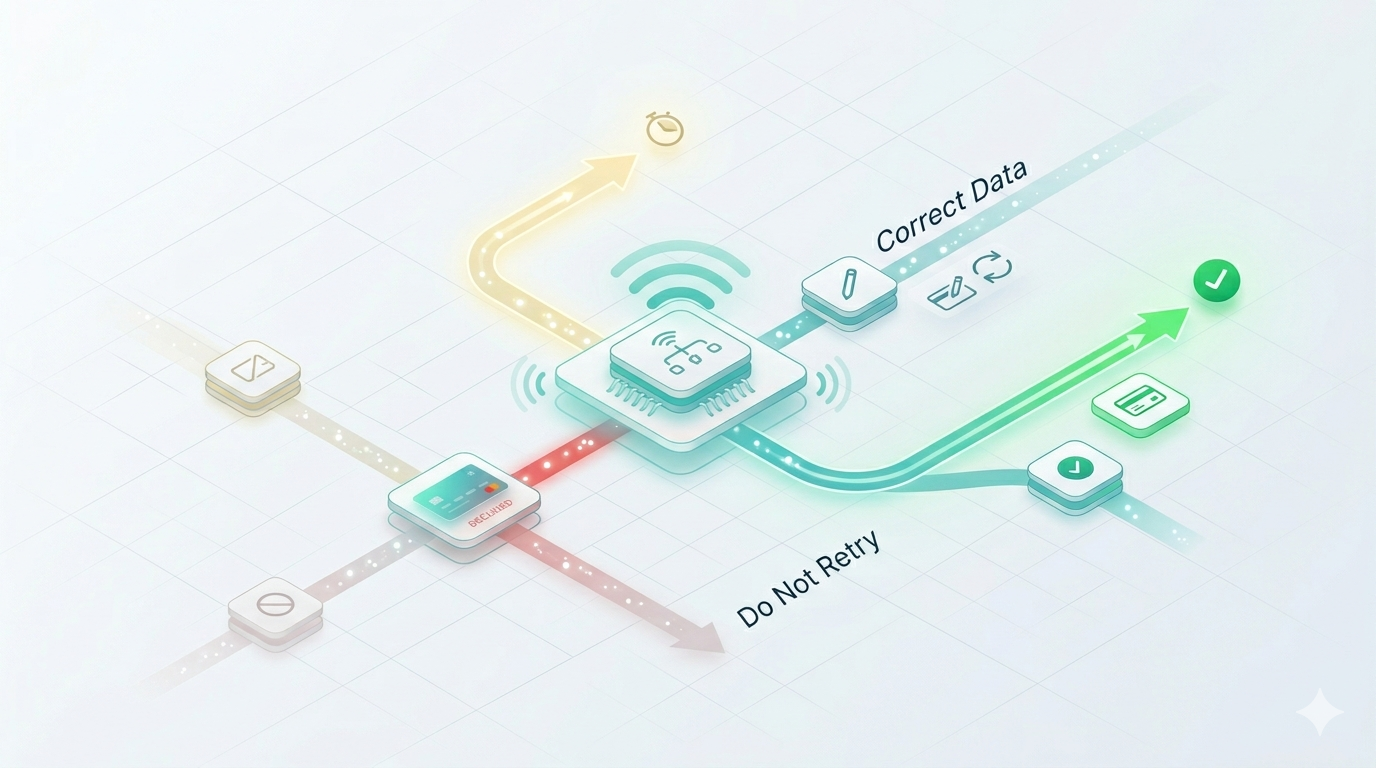
What Is Partial Authorization (and Why It Matters for Authorization Rates)
A technical guide to partial authorization in card payments - how issuers approve less than the requested amount, why it happens at fuel pumps, hotels, and prepaid terminals, and what merchants and processors must do to handle the shortfall correctly.
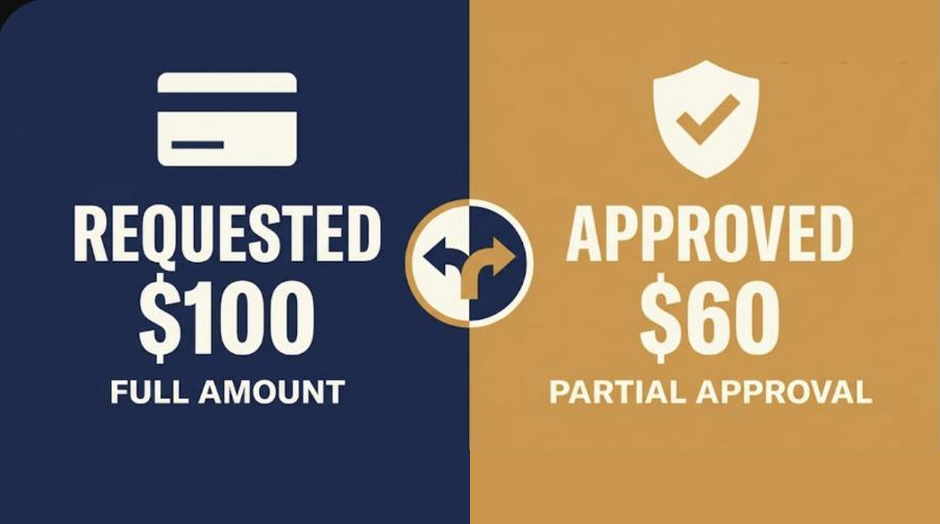
Partial authorization is a card network mechanism that lets an issuer approve a transaction for less than the amount requested, rather than declining it outright, shifting the responsibility for the shortfall to the merchant's point-of-sale or checkout flow.
What Partial Authorization Actually Is
In a standard authorization request, the merchant's acquirer sends the issuer a single requested amount and gets back an approval or a decline. Partial authorization introduces a third outcome: the issuer approves part of the requested amount because the cardholder's available balance can't cover the whole thing.
Why the Issuer Doesn't Just Decline
Partial authorization exists because a hard decline destroys value that a split payment could capture. Visa states its partial authorization service can lift approval rates by roughly 25 basis points and reports that its network processes more than 140 million partial-approval transactions annually - a volume that only makes sense in categories where "insufficient balance" is a routine, expected condition rather than an edge case (Visa Partial Authorization Service). Four categories account for most of that volume.
Automated Fuel Dispensers
Fuel is the canonical partial-authorization use case because the merchant can't know the final sale amount before the pump runs. The transaction starts with a pre-authorization request - either a specific amount or a token amount that tells the host to apply a preconfigured limit - and the host places a hold for that amount and returns the pump limit the customer can actually draw against (Conexxus: Payment Processing for Retail Petroleum and Convenience). If a customer requests a $75 hold but only $20 is available on the card, the issuer can return a partial approval for $20 instead of declining the fill entirely, letting the customer pump up to that amount (Conexxus: Payment Processing for Retail Petroleum and Convenience). Once fueling completes, the site transmits the actual sale amount in a completion message, and the host releases the unused portion of the original hold (Conexxus: Payment Processing for Retail Petroleum and Convenience). Visa treats automated fuel dispensers as a special case in its own architecture: AFDs on real-time clearing use a customized authorization framework distinct from the estimated/incremental model used elsewhere, and dispensing only the approved amount - with the clearing record matching the fuel actually pumped - is a mandatory merchant requirement, not a best practice (Visa Partial Authorization Service; Visa: Authorization and Reversal Processing Best Practices for Merchants).
Lodging, Car Rental, and Cruise
These merchants face the opposite timing problem: the final charge (room service, incidentals, damage, extra days) isn't known until checkout, so the initial authorization is deliberately an estimate. Visa requires that an estimated authorization be a genuine, calculated estimate rather than an arbitrary placeholder, flagged with its own indicator value in the same authorization field used for partial-auth flagging, and it sets network-defined validity windows for how long that authorization holds before it needs to be reconfirmed - 30 days for lodging, vehicle rental, and cruise merchants, and shorter windows (5-10 days) for other card-present and card-absent categories (Visa: Authorization and Reversal Processing Best Practices for Merchants). When the estimate turns out to be too low, the merchant submits an incremental authorization referencing the same transaction identifier as the original estimate to top it up (Visa: Authorization and Reversal Processing Best Practices for Merchants). Partial authorization sits underneath this whole flow: if the cardholder's available balance can't support even the increment, the issuer can approve a smaller amount than requested rather than reject it, which is why Visa recommends partial-authorization support across these categories as a way to preserve approvals it would otherwise lose to balance mismatches (Visa: Authorization and Reversal Processing Best Practices for Merchants).
Prepaid, Gift, and Healthcare (FSA/HSA) Cards
Prepaid and gift cards have hard, non-negotiable balance ceilings - there's no line of credit behind them to absorb a shortfall - which makes them one of the highest-frequency sources of low-balance declines that partial authorization is designed to intercept. Healthcare cards add a second layer: FSA and HRA purchases at general-merchandise retailers must run through an IIAS (Inventory Information Approval System) that separates eligible medical items from ineligible ones at the SKU level. The body that certifies IIAS compliance, SIG-IS, explicitly recommends that merchants implementing IIAS support partial authorization for mixed baskets, so that the eligible portion of the purchase is approved on the FSA/HRA card while the ineligible items and the difference are collected through another tender rather than causing the entire authorization to fail (SIG-IS: Cardholders).
What the Merchant Has to Do With a Partial Approval
A partial approval is not a settled transaction - it's a conditional one, and the network rules are specific about what happens next. Visa's guidance requires that clearing (the settlement record sent to the acquirer) reflect only the partially approved amount, not the originally requested amount, and that eCommerce merchants present the customer with an alternate payment method for the remainder rather than silently failing the checkout (Visa Partial Authorization Service). In restaurant and tipping environments, Visa requires the pre-tip amount to be what's submitted for authorization and, when a partial approval comes back, two receipts - one without a tip line for the approved amount, and a second showing the balance due with a tip line - with no tolerance applied to the partially approved figure (Visa Partial Authorization Service). CyberSource's processing documentation frames the merchant's options plainly once a partial approval lands: run a second card for the balance, adjust the transaction total, or void it - but the capture for the original authorization simply doesn't proceed automatically (CyberSource: Partial Authorizations). Get any of this wrong - clear for the full requested amount instead of the approved amount, or fail to reverse the unused portion of a fuel or lodging hold - and the transaction stops looking like a partial approval and starts looking like a mismatched authorization, which is exactly the condition Visa's misuse-of-authorization and unmatched-clearing fees are designed to penalize (Visa: Authorization and Reversal Processing Best Practices for Merchants).
Where the Model Breaks Down in Practice
The failure mode isn't usually the network message - it's the systems downstream of it. A gateway, POS application, or checkout SDK that doesn't parse the partial-approval response code and instead treats anything other than a full "approved" as a decline will convert a capturable partial authorization into a false decline. A terminal that doesn't clear for the actually-approved amount, or that never reverses the unused portion of a hold, generates exactly the kind of authorization/clearing mismatch that draws network compliance fees regardless of whether the customer ever knew a partial approval happened. And because support for partial authorization varies by network, by card type, and - within a network - by issuer, a merchant's integration has to treat "partial approval" as a first-class response state rather than an occasional exception, on every rail it accepts.
That's also why partial authorization is worth treating as infrastructure rather than a POS edge case. It sits in the same category as retry orchestration and soft-decline handling: a defined, network-sanctioned signal that a transaction is capturable, which only produces revenue if the systems reading it are built to act on the signal correctly - routing the shortfall to a second payment method, reconciling the clearing record to the approved amount, and reversing unused holds - instead of collapsing it into a generic decline.
Frequently Asked Questions
Is a partial approval the same as a decline?